Are Epoxy Floors Slippery? Safety Guide for 2026
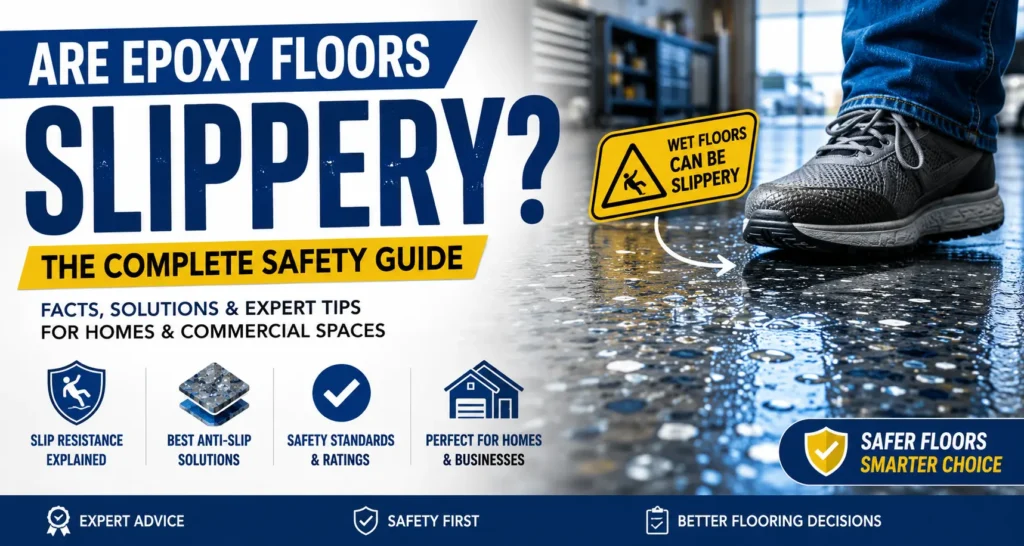
Epoxy floors are not slippery when dry. A smooth, high-gloss epoxy surface can become slippery when wet, oily, or contaminated. Most professional epoxy flooring systems use anti-slip additives like aluminum oxide, silica sand, decorative flakes, or quartz aggregate to create traction. With the right system and proper installation, epoxy floors can meet and exceed safe slip resistance standards for homes, garages, and commercial buildings.
Quick Safety Checklist:
- Dry epoxy: generally safe traction
- Wet or oily epoxy without additives: slip risk
- Flake or quartz epoxy systems: strong grip, wet or dry
- Anti-slip topcoat applied: significantly improved safety
- Regular cleaning and maintenance: keeps traction reliable
[Get a Free Epoxy Flooring Quote in Austin, TX → Contact Us Today]
Understanding Epoxy Flooring Before We Discuss Slip Resistance
What Is Epoxy Flooring?
Epoxy flooring is a surface coating system applied directly to concrete. It combines epoxy resin and a hardening agent. When mixed and cured, these two components bond into a dense, seamless, and highly durable surface.
It is used in residential garages, warehouses, manufacturing plants, commercial kitchens, hospitals, retail stores, auto repair shops, and aircraft hangars. The seamless nature of epoxy makes it easy to clean and resistant to stains, chemicals, and heavy foot traffic.
How Epoxy Bonds to Concrete
Professional installers grind and profile the concrete slab before applying epoxy. This mechanical bond locks the epoxy coating in place. A properly bonded epoxy system will not peel, bubble, or delaminate under normal use.
The bond also affects surface texture. Floors ground to a coarser profile tend to hold additives better. That matters when you are building in slip resistance from the ground up.
Why Epoxy Is Popular Across America
Epoxy flooring has grown in popularity for good reason. It costs less than tile or hardwood over time. It handles heavy equipment without cracking. It resists motor oil, chemicals, and cleaning agents. And it looks sharp in just about every setting.
But the glossy look sometimes creates a false impression. Many people assume shiny equals slippery. That assumption is not always accurate.
Are Epoxy Floors Slippery When Dry?
The short answer is no. Dry epoxy floors provide adequate traction for most foot traffic when properly installed.
A smooth epoxy surface without anti-slip additives has a static Coefficient of Friction in the range of 0.50 to 0.55 when dry. That falls just at or above the commonly referenced minimum threshold. It is not dangerously slick on its own, but it also does not offer the same grip as a textured surface.
Add aluminum oxide, silica sand, or decorative flakes, and the dry COF rises well above 0.6. That is the level the National Floor Safety Institute identifies as acceptable for most walking surfaces.
How Dry Epoxy Compares to Other Flooring
Flooring Type Dry Traction Notes
| Flooring Type | Dry Traction | Notes |
|---|---|---|
| Smooth Epoxy | Moderate | COF approx. 0.50 to 0.55 |
| Flake or Quartz Epoxy | Good to Excellent | COF above 0.65 |
| Bare Concrete | Moderate | Varies by surface profile |
| Glazed Ceramic Tile | Moderate | COF approx. 0.70 without grit |
| Vinyl Composition Tile | Moderate to Low | Slippery when wet |
| Polished Concrete | Low to Moderate | Highly slippery when wet |
| Hardwood (sealed) | Moderate | Can be slick in socks |
Dry, textured epoxy outperforms many common flooring materials. The myth that epoxy is inherently unsafe does not hold up when the data is considered.
Are Epoxy Floors Slippery When Wet?
Yes. Smooth, high-gloss epoxy can become slippery when wet. This is the most common situation where slip risk actually exists.
Epoxy cures into a non-porous, waterproof surface. When water lands on it, the liquid has nowhere to go. It sits on top and creates a low-friction film between your foot and the floor. That film dramatically reduces traction.
Why Water Reduces Traction
Water acts as a lubricant. On a sealed, smooth surface like polished epoxy, even a thin film of water can lower the COF enough to cause a slip. The smoother and glossier the surface, the more water affects it.
Why Oil Is More Dangerous Than Water
Oil is worse than water. Oil does not evaporate quickly, and it spreads further. A single small oil drip in a garage or commercial kitchen creates a wide, invisible hazard zone. On smooth epoxy, oil can reduce the COF to extremely unsafe levels without any visible warning signs.
The Sweating Floor Problem
Temperature changes cause condensation. When warm air meets a cold concrete slab, moisture forms on the surface. This is common in garages and basements in states like Minnesota, Michigan, Ohio, and Colorado during seasonal transitions. It is one of the most underappreciated slip risks associated with epoxy flooring.
The fix is straightforward: a textured topcoat. Without it, a sweating floor becomes a safety hazard with no visible warning.
What Makes Some Epoxy Floors More Slippery Than Others?
Not all epoxy floors are built the same. Several factors determine how slippery a surface will be.
High-Gloss Finishes
Solid-color epoxy floors with a mirror-like gloss finish are the most prone to becoming slippery when wet. They look stunning, but they offer limited mechanical grip.
Poor Installation Practices
Rushed or DIY installations often skip anti-slip additives entirely. They also produce thinner coats with a weaker texture. A floor installed without proper aggregate broadcast is a floor waiting to cause a slip-and-fall incident.
Lack of Anti-Slip Additives
This is the single biggest factor. A floor without aluminum oxide, silica sand, or similar aggregate in the topcoat has less grip. Period.
Excessive Floor Contamination
Oil, grease, fine dust, flour, and other dry powders all reduce traction. Dry powders are particularly dangerous because they act like tiny ball bearings underfoot. Even a well-textured floor can become slippery if it is not kept clean.
Heavy Commercial Traffic
High foot traffic wears down surface texture over time. Anti-slip additives embedded in the topcoat can degrade in areas with constant wheeled equipment or foot traffic. Regular inspection and recoating keep the floor safe long-term.
Slip Resistance Ratings Explained
This is the section most competitors ignore. Understanding COF ratings helps you make smarter decisions when choosing a flooring system.
What Is the Coefficient of Friction?
The Coefficient of Friction, or COF, is a number that measures how much resistance a surface provides to sliding motion. A higher COF means more traction. A lower COF means more slip risk.
Two types matter in flooring:
1. Static COF (SCOF): Resistance before motion starts
2. Dynamic COF (DCOF): Resistance while a foot is already moving
Dynamic COF is generally considered more relevant for real-world slip-and-fall prevention.
What Is a Safe COF Rating?
The National Floor Safety Institute recommends a COF of at least 0.6 for most walking surfaces. The ADA requires that accessible floor surfaces be “slip-resistant” and specifies 0.6 on flat surfaces and 0.8 on ramps for public buildings.
OSHA does not mandate a specific COF number. Still, it does require employers to maintain safe walking surfaces under 29 CFR Part 1910, Subpart D. Failing to address slippery conditions exposes businesses to citations, workers’ compensation claims, and legal liability.
Why This Matters for Epoxy
A professionally installed epoxy system with anti-slip additives can achieve a COF of 0.7 or higher. That exceeds the safe threshold for both general use and ADA-accessible spaces. Smooth, untreated epoxy sits at approximately 0.50 to 0.55, which is marginal at best.
The difference is not the epoxy itself. It is what goes into the system.
How to Make Epoxy Floors Less Slippery
There are several proven methods to improve traction on epoxy floors. Professional installers build these into the system from the start.
Anti-Slip Additives
The most effective method. Fine-grain aggregates are broadcast into the wet topcoat layer before it cures. Common options include:
1. Aluminum oxide: Hard, durable, excellent for heavy-traffic areas and garages
2. Silica sand: Cost-effective, fine or coarse-grain options available
3. Quartz aggregate: Strong grip, great in commercial and industrial settings
4. Polypropylene beads: Softer texture, better suited for residential spaces
5. Glass beads: Smooth texture with a modest traction improvement
Aluminum oxide is the most popular choice for garage floors and commercial spaces. It lasts longer and handles vehicle traffic well.
Decorative Flake Systems
Vinyl flakes broadcast into epoxy create natural texture variation across the floor. They improve both appearance and grip. Flake floors are extremely popular in residential garages across Austin and throughout Texas.
Polyaspartic Topcoats
Polyaspartic topcoats cure faster and hold up better to UV exposure than standard epoxy topcoats. They are compatible with anti-slip additives and maintain texture longer in high-traffic environments. Many professional installers recommend polyaspartic as a final topcoat over an epoxy base.
Non-Skid Sealers
For existing smooth epoxy floors that need a safety upgrade, a non-skid sealer is a practical solution. It adds a textured coating over the existing surface without a full reinstall.
Which Epoxy Flooring Systems Offer the Best Traction?
| Flooring System | Dry Grip | Wet Grip | Maintenance | Best Use |
|---|---|---|---|---|
| Solid Color Epoxy | Moderate | Low | Easy | Light residential use |
| Flake Epoxy | Good | Good | Easy | Garages, basements, showrooms |
| Quartz Epoxy | Excellent | Excellent | Moderate | Commercial kitchens, hospitals |
| Metallic Epoxy | Moderate | Low to Moderate | Easy | Decorative residential floors |
| Polyaspartic Coatings | Good to Excellent | Good | Easy | All-purpose, UV-stable spaces |
| Urethane Cement Flooring | Excellent | Excellent | Moderate | Food processing, industrial plants |
For wet or oily environments, quartz epoxy and urethane cement are the top performers. For standard residential garages in Austin, flake epoxy with aluminum oxide topcoat is the most popular and practical choice.
Are Epoxy Garage Floors Slippery?
Garage floors face unique challenges. Cars track in rainwater, snow melt, oil, transmission fluid, and road grime. Without a textured topcoat, a glossy garage floor can turn into a slip hazard every time it rains.
Rainwater and Snow Melt
In states like Minnesota, Wisconsin, Michigan, and New York, winter brings tracked-in snow and ice melt. This creates a constant wet-floor situation. Smooth epoxy in these climates is a liability without an anti-slip texture.
Even in Texas, sudden rainstorms push water into garages quickly. A flake system with a silica sand or aluminum oxide topcoat handles this without issue.
Oil and Transmission Fluid
Oil is the biggest hazard in auto repair shops and residential garages. A quartz or aluminum oxide additive system keeps traction reliable even when minor oil drips are present.
Best Texture Options for Garage Floors
For garage floors, most professionals recommend:
1. Full-flake epoxy with aluminum oxide topcoat
2. Quartz-broadcast system for heavy vehicle use
3. Polyaspartic topcoat with anti-slip additive for fast turnaround
[Want a Slip-Resistant Garage Floor in Austin? Request Your Free Quote →]
Are Epoxy Floors Safe for Commercial Buildings?
Yes, when properly specified and installed. Commercial environments have higher liability exposure, which means getting the slip resistance right is not optional.
Warehouses
Warehouse floors deal with forklifts, pallet jacks, foot traffic, and the occasional liquid spill. A quartz epoxy or urethane cement floor with anti-slip aggregate handles all of it. Slip-and-fall injuries in warehouses are among the most expensive workplace incidents. According to Liberty Mutual’s 2024 Workplace Safety Index, same-level falls cost employers nearly $10 billion per year in medical expenses and lost wage claims.
Commercial Kitchens and Restaurants
Commercial kitchens require the highest level of slip resistance because of constant grease, water, and soap exposure. Urethane cement or quartz broadcast epoxy rated above COF 0.65 wet is the standard. Health codes in most states also require slip-resistant flooring in food preparation areas.
Hospitals and Healthcare Facilities
Hospitals see constant foot traffic in often wet conditions, particularly near entrances, restrooms, and patient rooms. Epoxy with a polypropylene bead or fine quartz additive offers a clean, sterile appearance while meeting ADA and safety requirements.
Retail Stores
Retail floors need a balance of aesthetics and safety. Flake epoxy systems with a subtle anti-slip texture satisfy both requirements without sacrificing the clean, professional look customers expect.
[Infographic idea: Visual layout of commercial flooring systems by industry with recommended COF levels — hospitals, kitchens, warehouses, retail]
Epoxy Floors vs Other Flooring Types for Slip Resistance
| Flooring Type | Dry COF | Wet COF | Slip Risk |
|---|---|---|---|
| Flake Epoxy | 0.65+ | 0.55+ | Low |
| Smooth Epoxy | 0.50 to 0.55 | 0.30 to 0.40 | Moderate to High |
| Glazed Ceramic Tile | 0.70 | 0.10 to 0.34 | High when wet |
| Polished Concrete | 0.55 | 0.25 | High when wet |
| Vinyl Composition Tile | 0.50 | 0.20 | Very High when wet |
| Rubber Flooring | 0.80+ | 0.70+ | Low |
| Sealed Concrete | 0.60 | 0.40 | Moderate |
Properly textured epoxy competes well with most commercial flooring options. Its wet performance, when additives are used, significantly outpaces glazed tile and polished concrete.
Common Myths About Slippery Epoxy Floors
Myth 1: All Epoxy Floors Are Slippery
False. Only smooth, untextured epoxy floors present a real slip risk. Modern systems with anti-slip additives meet and exceed industry safety standards.
Myth 2: Glossy Always Means Unsafe
Gloss level is about light reflection, not friction. A glossy floor with aluminum oxide in the topcoat provides strong traction while still looking polished and bright.
Myth 3: Bare Concrete Is Safer Than Epoxy
Not true. Bare concrete absorbs liquids and can harbor mold, bacteria, and pitting. A professionally coated epoxy floor with proper texture outperforms bare concrete on almost every safety and hygiene metric.
Myth 4: Anti-Slip Additives Ruin the Appearance
Modern anti-slip additives are designed to be nearly invisible. A fine-grain silica sand or polypropylene bead topcoat adds grip without noticeably changing the look of the floor.
Myth 5: Epoxy Is Unsafe for Pets
Dogs and cats can struggle on very smooth floors. But a flake epoxy or quartz system provides plenty of grip for pet paws. Many homeowners specifically request added texture for this reason.
Maintenance Tips to Keep Epoxy Floors Safe
A well-maintained floor stays slip-resistant longer. These habits matter.
Remove Standing Water Promptly
After mopping or following a spill, remove standing water quickly. Do not leave puddles to dry on their own in high-traffic areas.
Clean Oil Spills Immediately
Use a neutral pH degreaser and clean oil spills as soon as they occur. Do not leave oil on the surface for extended periods. Old, dried oil is just as slippery as fresh oil.
Use Proper Cleaning Products
Avoid bleach, harsh solvents, and acid-based cleaners on epoxy. These break down the topcoat over time. Use a neutral cleaner designed for coated floors. Your installer should provide a recommended product list.
Inspect High-Traffic Areas Regularly
Check heavily trafficked zones every 6 to 12 months. Look for worn texture, surface erosion, or areas where the anti-slip additive has been abraded away. Catching these spots early is far cheaper than a full recoat.
Reapply Anti-Slip Coatings
In commercial and industrial environments, plan for a topcoat refresh every 3 to 5 years, depending on traffic levels. A thin recoat with fresh anti-slip additive restores full traction quickly and cost-effectively.
Final Verdict: Are Epoxy Floors Slippery?
A professionally installed epoxy floor with decorative flakes, silica sand, aluminum oxide, or another anti-slip additive is safe. It is not inherently slippery.
The risk exists only in specific cases. Smooth, high-gloss epoxy without any texture or additive can become slippery when wet, oily, or contaminated. That situation is entirely preventable with proper system design.
The safest options are flake epoxy, quartz-broadcast epoxy, or a polyaspartic system with anti-slip topcoat. These meet NFSI, ADA, and OSHA expectations while maintaining the clean, durable look epoxy is known for.
If you are installing epoxy flooring in Austin, TX, the right system starts with the right installer. Choose a company that builds slip resistance into every floor from day one, not as an afterthought.